Introduction
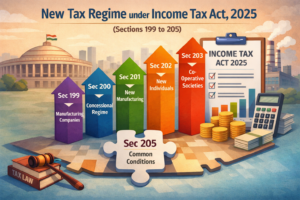
India’s concessional tax framework—originally introduced through Sections 115BA to 115BAE—has now been systematically reorganized under the Income Tax Act, 2025 into Sections 199 to 205.
This is not a policy overhaul, but a legislative redesign aimed at:
- improving clarity,
- reducing duplication, and
- creating a unified “New Tax Regime” code.
The real significance lies in structural coherence, not rate changes.
Mapping: Old vs New Law
| Earlier Section (1961 Act) | New Section (2025 Act) | Scope | Tax Rate |
|---|---|---|---|
| 115BA | Sec 199 | Manufacturing domestic companies | 25% |
| 115BAA | Sec 200 | General concessional regime (domestic companies) | 22% |
| 115BAB | Sec 201 | New manufacturing companies | 15% (subject to conditions); 22% / 30% if conditions fail and other provisions apply |
| 115BAC | Sec 202 | Individuals & other persons | Slab Rates under New Tax Regime |
| 115BAD | Sec 203 | Co-operative societies | 22% |
| 115BAE | Sec 204 | New manufacturing co-operative societies | 15% |
| — | Sec 205 | Common conditions | No separate rate |
Section 199: Manufacturing Domestic Companies
(Earlier Section 115BA)
Section 199 continues the concessional framework for existing domestic manufacturing companies.
Key Features:
- Concessional tax rate of 25%
- Intended for eligible manufacturing companies
- Optional regime subject to statutory conditions
- Restriction on specified deductions and incentives
Eligibility Criteria
To opt for Section 199:
- Taxpayer must be a domestic company.
- Company should be engaged in manufacture or production of any article or thing.
- Company should not be engaged in trading or service business except incidental activities.
- Option must be exercised in prescribed manner on or before due date of return.
Conditions / Restrictions
The company should not claim specified deductions/incentives such as:
- Additional depreciation
- Investment allowance
- SEZ deductions
- Profit-linked deductions under Chapter VIII of the Income Tax Act, 2025 (corresponding to earlier Chapter VI-A), except specifically permitted deductions.
- Set-off of brought forward losses attributable to above deductions
Practical Note:
This section has limited practical relevance today, as most companies prefer Sections 200 or 201 due to more attractive rates.
Section 200: Concessional Regime for Domestic Companies (22%)
(Earlier Section 115BAA)
Section 200 is the backbone of the corporate concessional tax regime.
Key Features:
- Flat 22% tax rate
- No MAT applicability
- No major deductions/exemptions allowed
- Irrevocable option
Eligibility Criteria
- Taxpayer must be a domestic company.
- Can be manufacturing, trading, or service company.
- Option to be exercised in prescribed manner before due date of return.
- Once exercised, the option is generally irrevocable.
Conditions
Company cannot claim specified exemptions/deductions such as:
- Additional depreciation
- Weighted deductions
- SEZ deduction
- Investment-linked deduction
- Certain Chapter VIII (earlier Chapter VI-A) deductions
No set-off of losses relating to such deductions.
Practical Significance:
This is the default concessional regime for most domestic companies.
Section 201: New Manufacturing Companies (15%)
(Earlier Section 115BAB)
Section 201 provides the most concessional corporate tax rate (15%), but with strict eligibility conditions.
Key Features
- Tax rate of 15%
- Intended to promote fresh manufacturing investment in India
- Strict eligibility and anti-abuse safeguards
Eligibility Criteria
- Taxpayer must be a domestic company.
- Company should be newly incorporated within prescribed dates.
- Must commence manufacturing within prescribed timeline.
- Must be engaged only in manufacture/production.
- Should not use old plant & machinery beyond permitted limit.
- Should not be formed by splitting up/reconstruction of existing business.
- Must exercise option in prescribed manner.
Conditions / Restrictions
- No claim of specified deductions or exemptions
- Related-party transactions must satisfy arm’s length standards
- Artificial profit shifting may invite recomputation
Important Clarification
Section 201 itself prescribes only the 15% tax rate.
If the company fails to satisfy conditions:
| Scenario | Applicable Provision | Tax Rate |
| Eligible under Section 200 | Section 200 | 22% |
| Not eligible for concessional regime | Normal provisions | 30% |
Thus, alternate rates arise from other provisions—not from Section 201 itself.
Section 202: New Tax Regime for Individuals
(Earlier Section 115BAC)
Section 202 codifies the default tax regime for individuals and similar taxpayers.
Eligible Persons
- Individual
- Hindu Undivided Family (HUF)
- Association of Persons (AOP)
- Body of Individuals (BOI)
- Artificial Juridical Person (where applicable)
Tax Rate
Applicable slab rates under New Tax Regime.
(Indicative structure)
| Total Income | Rate |
| Up to ₹4,00,000 | Nil |
| ₹4,00,001 – ₹8,00,000 | 5% |
| ₹8,00,001 – ₹12,00,000 | 10% |
| ₹12,00,001 – ₹16,00,000 | 15% |
| ₹16,00,001 – ₹20,00,000 | 20% |
| ₹20,00,001 – ₹24,00,000 | 25% |
| Above ₹24,00,000 | 30% |
Conditions
Most exemptions and deductions are not available, including:
- Deductions under Chapter VIII
- House Rent Allowance (HRA), subject to law
- Leave Travel Concession (LTC/LTA)
- Certain house property loss benefits
- Interest deduction for self-occupied property, subject to conditions
Certain deductions may continue where specifically permitted by law in force.
Practical Insight
This continues as the default regime, with option to opt out in eligible cases.
Section 203: Co-operative Societies (22%)
(Earlier Section 115BAD)
Section 203 extends the concessional framework to co-operative societies.
Key Features
- Tax rate of 22%
- Broadly mirrors the structure of Section 200
Eligibility Criteria
- Taxpayer must be a resident co-operative society.
- Option exercised in prescribed manner.
- Once exercised, generally irrevocable.
Conditions
- No specified deductions/exemptions.
No set-off of losses linked to such deductions.
Section 204: New Manufacturing Co-operative Societies (15%)
(Earlier Section 115BAE)
Section 204 provides a 15% concessional regime for new manufacturing co-operative societies.
Key Features
- Tax rate of 15%
- Encourages industrial growth through the co-operative model
Eligibility Criteria
- Must be resident co-operative society.
- Newly set up within prescribed dates.
- Engaged in manufacturing/production.
- Must commence production within prescribed timeline.
- No reconstruction of existing business.
Conditions
- No specified deductions
- Restrictions on use of old plant and machinery
- Operates in harmony with Section 205
Section 205 – The Core Structural Reform
Section 205 is the most important drafting innovation in the 2025 Act.
It provides:
- Unified conditions for Sections 200–204
- Disallowance of deductions
- Restrictions on set-off of losses
- Rules for depreciation adjustments
Before vs Now
| Earlier Law | 2025 Act |
| Conditions repeated in each section | Single consolidated provision |
| Complex provisos | Structured framework |
| Interpretation issues | Greater clarity |
Conclusion
The Income Tax Act, 2025 transforms the New Tax Regime into a coherent and integrated code:
- ✔ Sections 199–204 replace fragmented provisions
- ✔ Section 205 ensures uniformity
- ✔ No change in tax burden—only clarity
The reform represents a move towards “legislative minimalism with functional efficiency”—a cleaner law without altering its substance.
Disclaimer
This article is for educational purposes based on the Income Tax Act, 2025 and should not be considered professional advice.