
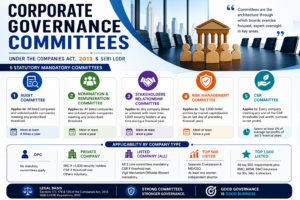
The Companies Act, 2013 introduced a structural overhaul of corporate governance in India. Among its most enduring contributions is the mandatory committee framework — a tiered set of board-level bodies, each carrying distinct responsibilities, composition rules, and meeting requirements. Depending on a company’s size, listing status, and market capitalisation, some or all of these committees become legally obligatory.
The full committee landscape has three layers: five committees specifically mandated under the Companies Act and SEBI LODR; a further set of voluntary committees that well-governed boards increasingly constitute based on their size and complexity; and additional mandatory committees prescribed by sector regulators such as RBI and IRDAI for banks, insurers, and NBFCs. This article covers all three.
This article walks through each committee in depth, examines how applicability shifts across different company structures — from a One Person Company (OPC) at one end, to the top 1000 listed entities at the other — and distils the practical implications for board secretaries, independent directors, and compliance officers.
Why Committees Exist
A full board meeting is effective for strategic decisions but ill-suited for the granular work of auditing financial statements, evaluating director remuneration, or adjudicating shareholder grievances. Committees solve this by concentrating expertise. They derive their authority from the board’s delegation and report back to the board, which retains ultimate accountability.
Under Section 177 of the Companies Act, the Board may delegate certain matters to committees constituted for that purpose. Both the Act and the SEBI (Listing Obligations and Disclosure Requirements) Regulations, 2015 — known as the SEBI LODR — specify mandatory committees for prescribed classes of companies.
“Committees are not bureaucratic formality — they are the architecture through which boards exercise focused, expert oversight in areas that generalist meetings cannot adequately address.”
Statutory Mandatory Committees (Companies Act & SEBI LODR)
The following five committees are mandated by statute. Their composition, quorum, meeting frequency, and functions are specifically prescribed — non-compliance attracts penalties under the Companies Act or SEBI LODR.
1. Audit Committee
Section 177 · Companies Act, 2013 | SEBI LODR Regulation 18
Applies to every listed public company and to unlisted public companies that cross any one of these thresholds:
- paid-up capital of Rs. 10 crore or more; or
- turnover of Rs. 100 crore or more; or
- aggregate outstanding loans, debentures and deposits exceeding Rs. 50 crore.
Composition:
Under the Companies Act:
- minimum 3 directors,
- majority independent,
- majority (including chairperson) must be able to read financial statements.
Under SEBI LODR:
- 2/3rd must be independent,
- all members financially literate,
- at least one with accounting/financial management expertise,
- chairperson must be an independent director.
Meeting Frequency
Must meet at least four times a year with no more than 120 days between consecutive meetings.
Quorum
2 members or 1/3rd of members (whichever greater) including at least 2 independent directors.
Key functions:
- Oversight of financial reporting,
- auditor appointment,
- related party transaction approvals,
- internal controls,
- whistle-blower mechanism.
2. Nomination & Remuneration Committee (NRC)
Section 178 · Companies Act, 2013 | SEBI LODR Regulation 19
Applies to every listed public company and to unlisted public companies that cross any one of these thresholds:
- paid-up capital of Rs. 10 crore or more; or
- turnover of Rs. 100 crore or more; or
- aggregate outstanding loans, debentures and deposits exceeding Rs. 50 crore.
Composition:
Under Companies Act:
- 3 or more non-executive directors,
- at least half independent.
Under SEBI LODR:
- all non-executive,
- at least 50% independent,
- chairperson must be an independent director.
Meeting Frequency
Must meet at least once a year.
Key functions
- Ccriteria for director qualifications,
- independence and remuneration policy;
- board diversity policy;
- performance evaluation of independent directors;
- recommendation of appointments and removals of directors and senior management.
3. Stakeholders Relationship Committee (SRC)
Section 178(5) · Companies Act, 2013 | SEBI LODR Regulation 20
Applicable to any company — listed or unlisted, public or private — with more than 1,000 shareholders, debenture-holders, deposit-holders, or other security holders at any time during a financial year must constitute this committee.
Composition
Under Companies Act:
- chairperson must be a non-executive director.
Under SEBI LODR:
- minimum 3 directors,
- all non-executive,
- at least one independent director,
- non-executive director as chairperson.
Meeting Frequency
Must meet at least once a year.
Key functions:
- resolving security holder grievances including share transfers,
- non-receipt of dividends,
- duplicate certificates;
- reviewing service standards of Registrar & Share Transfer Agents;
- review of unclaimed dividend measures.
4. Risk Management Committee
SEBI LODR Regulation 21
Required for the top 1,000 listed entities by market capitalisation, as determined at the end of the immediately preceding financial year.
Not required under the Companies Act — this is a SEBI LODR mandate (Regulation 21) reflecting elevated governance expectations for India’s largest market participants.
Composition
- Minimum 3 members;
- majority must be board directors including at least one independent director;
- senior executives may also serve as members;
- chairperson must be a board member.
Meeting Frequency
Must meet at least twice a year, with no more than 180 days between meetings.
Key functions
- formulating a detailed risk management policy;
- monitoring its implementation;
- identifying internal and external risks;
- reviewing the appointment and remuneration of the Chief Risk Officer.
5. Corporate Social Responsibility (CSR) Committee
Section 135 · Companies Act, 2013
Every company — listed or unlisted, public or private — meeting any one of:
- net worth of Rs. 500 crore or more;
- turnover of Rs. 1,000 crore or more;
- or net profit of Rs. 5 crore or more during preceding financial year.
Composition
- Minimum 3 directors including at least one independent director.
- If the total CSR spend obligation does not exceed Rs. 50 lakh, the committee need not be constituted — the board itself may discharge its functions.
Key functions
- formulate and recommend a CSR policy indicating activities to be undertaken;
- recommend expenditure amount;
- monitor policy implementation.
Companies must spend at least 2% of average net profits of the three immediately preceding financial years on Schedule VII activities.
Applicability Matrix — Statutory Mandatory Committees
| Committee | OPC | Private Co. | Listed Co. | Top 1000 Listed |
| Audit Committee | Not applicable | If public co. thresholds met | Mandatory | Mandatory (stricter) |
| Nomination & Remuneration | Not applicable | If public co. thresholds met | Mandatory | Mandatory (stricter) |
| Stakeholders Relationship | Not applicable | If >1,000 sec. holders | Mandatory | Mandatory |
| Risk Management | Not applicable | Not applicable | Not required | Top 1000 only |
| CSR Committee | Not applicable | If threshold met | If threshold met | Usually required |
Important: The SEBI LODR requirements consistently set a higher bar than the Companies Act. Wherever they diverge on composition, quorum, or meeting frequency, listed companies must comply with the more stringent LODR standard.
Voluntary & Best-Practice Committees
Beyond statutory committees prescribed under the Companies Act, 2013 and SEBI (LODR) Regulations, boards have considerable flexibility to constitute additional committees based on business complexity, industry risks, and governance requirements. These committees are generally not mandatory for companies at large; however, certain sectoral regulators such as RBI, IRDAI, and SEBI may prescribe specialized governance frameworks for regulated entities. Further, institutional investors, proxy advisory firms, and global governance standards increasingly encourage the adoption of such committees as best practices.
| Committee | Purpose | Who Constitutes |
| Investment Committee | Oversight of treasury, investments and capital allocation decisions | Holding companies, NBFCs, treasury-intensive companies, large corporates |
| Finance Committee | Reviews financing strategy, borrowings, treasury, capital expenditure and delegated financial approvals | Mid to large companies with complex financing |
| Ethics & Compliance Committee | Oversees code of conduct, anti-bribery, anti-corruption and regulatory compliance | MNC subsidiaries, regulated entities, companies with overseas operations, and governance-focused listed entities |
| Strategy Committee | Assists board on long-term planning, major acquisitions, restructuring and long-term strategic direction | Large listed companies; conglomerates |
| IT / Cyber Security Committee | Monitors IT governance, cyber risk, data privacy and technology strategy | Banks, listed tech companies, large corporates |
| Executive / Mgmt. Committee | Handles routine operational decisions delegated by the board between meetings | Any company desiring faster operational decisions |
| IPO / Capital Markets Committee | Manages all decisions related to public offerings, rights issues and QIPs | Companies planning or executing market issuances |
| HR & Compensation Committee | Reviews broader HR policy, talent strategy and senior management succession plans | Large companies; supplement to NRC |
Sector-Specific Mandatory Committees
Companies operating in regulated industries face additional mandatory committee requirements prescribed by their respective sectoral regulators. These are separate from — and in addition to — the Companies Act and SEBI LODR requirements. Regulated entities must comply with both frameworks simultaneously.
| Sector | Regulator | Mandatory Committees |
| Banking | RBI / Banking Regulation Act | Audit Committee of the Board (ACB); Customer Service Committee; Special Committee for Monitoring Large-Value Frauds; IT Strategy Committee; Risk Management Committee; Nomination & Remuneration Committee; Special Committee on Wilful Defaulters |
| Insurance | IRDAI | Audit Committee; Risk Management Committee; Policyholders Protection Committee; Investment Committee; Nomination & Remuneration Committee; With-Profits Committee (life insurers) |
| NBFCs | RBI (Scale-Based Regulation) | Risk Management Committee (for upper and middle layer NBFCs); Audit Committee; Nomination & Remuneration Committee; Asset-Liability Management Committee (ALCO — typically management level) |
| Mutual Funds | SEBI (MF Regulations) | Audit Committee; Risk Management Committee of the AMC; Valuation Committee; Stewardship Committee |
| Stock Brokers | SEBI | Audit Committee; Risk Management Committee; Investor Grievance Redressal Committee |
Applicability by Company Type
1. One Person Company (OPC)
An OPC is exempt from the annual general meeting requirement and needs only two board meetings per calendar year. None of the five statutory committees apply. No voluntary committees are expected given the single-shareholder structure. However, if an OPC crosses size thresholds and converts to a private or public company, the full committee framework kicks in.
2. Private Company
Sections 177 and 178 (Audit Committee and NRC) target public companies. Private companies are generally exempt unless they individually meet the public company thresholds on paid-up capital, turnover, or borrowings. However:
- Stakeholders Relationship Committee applies if security holders exceed 1,000.
- CSR Committee applies if the company meets the net worth, turnover, or net profit thresholds.
- Voluntary committees (Finance, Investment, IT) are increasingly adopted by large private companies and PE-backed firms with institutional investors.
3. Listed Company (All)
All three core statutory committees (Audit, NRC, Stakeholders Relationship) are mandatory. Vigil mechanism (Whistle-Blower Policy) under LODR Regulation 22 is mandatory. CSR Committee applies if thresholds are met. In practice, most listed companies also constitute an Investment Committee, and many constitute an IT/Cyber Security Committee.
4. Top 500 Listed Companies
The roles of Chairperson and Managing Director or CEO must be separated — the Chairperson of the board may not be related to the MD or CEO. At least one independent woman director must be on the board.
5. Top 1,000 Listed Companies
All top-500 requirements apply, plus: Risk Management Committee becomes mandatory (SEBI LODR Regulation 21); Business Responsibility and Sustainability Report (BRSR) mandatory in annual report; D&O insurance for all independent directors; board must have minimum six directors.