Introduction
In today’s dynamic and risk-driven business environment, Internal Audit has emerged as a critical function for organizations. It is no longer limited to checking books of accounts; rather, it plays a vital role in strengthening governance, risk management, and internal control systems. As highlighted by the publications of the Institute of Chartered Accountants of India (ICAI), internal audit has evolved into a value-adding advisory function that helps organizations achieve their objectives efficiently.
What is Internal Audit?
Internal Audit is an independent, objective assurance and consulting activity designed to add value and improve an organization’s operations. It evaluates and enhances the effectiveness of:
- Risk management
- Internal control systems
- Governance processes
Unlike statutory audit, internal audit is continuous and management-oriented, focusing on improving processes rather than only reporting past financial results.
Benefits of Internal Audit
1. Improved Risk Management
Internal audit helps identify, assess, and mitigate risks across operations. Modern audit approaches use risk-based frameworks to focus on high-risk areas.
2. Strengthening Internal Controls
It evaluates whether controls are properly designed and functioning effectively, thereby reducing errors and fraud.
3. Better Governance
Internal auditors support the management and audit committee by providing independent insights into governance practices.
4. Operational Efficiency
By reviewing processes, internal audit suggests improvements that lead to cost savings and better resource utilization.
5. Compliance Assurance
Internal audit ensures that the organization complies with laws, regulations, and internal policies, reducing legal exposure.
6. Fraud Prevention and Detection
It acts as a preventive mechanism by identifying weak areas prone to fraud and recommending corrective actions.
7. Enhanced Decision Making
Management receives timely and reliable information for strategic decisions.
As per ICAI guidance, internal audit also contributes to improving efficiency, reliability of financial reporting, and regulatory compliance, making it a key pillar of organizational success.
Statutory Compliances Related to Internal Audit
1. Companies Act, 2013 (India)
Internal Audit has been given statutory recognition under Section 138 of the Companies Act, 2013, read with Rule 13 of the Companies (Accounts) Rules, 2014. The law mandates certain classes of companies to appoint an internal auditor to strengthen internal controls, risk management, and governance processes.
The requirement applies to:
- Listed companies
- Unlisted public companies meeting prescribed thresholds
- Private companies crossing specified turnover or borrowing limits
The internal auditor may be a Chartered Accountant, Cost Accountant, or any other professional as decided by the Board.
Applicability of Internal Audit
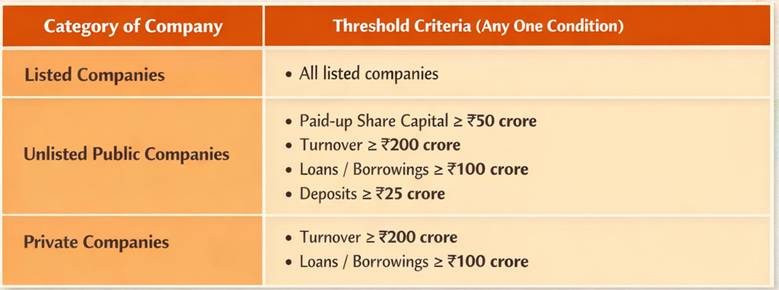
Key Points
- The criteria are alternative in nature, i.e., satisfying any one condition triggers applicability.
- Borrowings are considered based on the maximum outstanding amount during the financial year.
- Internal audit plays a crucial role in ensuring compliance with laws, operational efficiency, and risk mitigation.
2. Standards on Internal Audit (SIAs)
Issued by ICAI, these standards provide a framework and best practices for conducting internal audits. They cover areas such as:
- Planning (SIA 310)
- Documentation (SIA 330)
- Reporting (SIA 370)
- Risk management and governance
These standards help ensure quality, consistency, and professionalism in internal audit assignments.
3. Other Regulatory Requirements
Depending on the industry, internal audit is also influenced by:
- RBI guidelines (for banks and NBFCs)
- SEBI regulations (for listed entities)
- GST, Income Tax, and other statutory laws
- Industry-specific laws (e.g., insurance, hospitality, etc.)
For example, in banking, concurrent audit (a form of internal audit) ensures timely detection of irregularities and frauds.
Who Performs Internal Audit?
Internal audit can be conducted by:
- Internal Audit Department: Large organizations maintain an in-house internal audit team responsible for continuous monitoring.
- Chartered Accountants (CAs): Professional firms or practicing Chartered Accountants are commonly appointed due to their expertise in finance, risk, and controls.
- Cost Accountants / Other Professionals: As permitted under law, organizations may appoint other qualified professionals with relevant expertise.
- Outsourced/Internal Audit Firms: Many companies outsource internal audit to specialized firms for independence and technical expertise.
Role of Internal Auditor
The internal auditor acts as:
- Assurance provider – Validates controls and compliance
- Advisor – Suggests improvements in processes
- Risk evaluator – Identifies and mitigates risks
- Governance partner – Supports management and audit committees
Modern internal auditors are often called the “third line of defense” in risk management.
Conclusion
Internal Audit is a cornerstone of strong corporate governance. It not only ensures compliance and control but also adds strategic value by improving efficiency, managing risks, and enhancing decision-making. With increasing regulatory requirements and complex business environments, the role of internal audit continues to expand, making it indispensable for organizations aiming for sustainable growth.